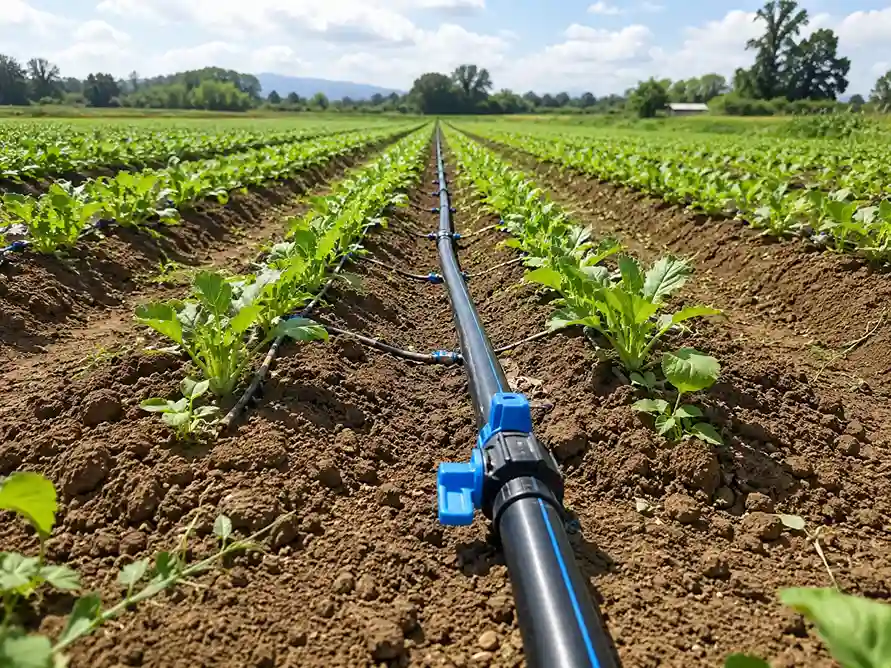
A reliable irrigation system does not only depend on the availability of water sources. The pipes used to distribute water throughout agricultural fields are equally important components.
Using unsuitable pipes can affect water distribution performance, reduce operational efficiency, and increase maintenance costs over time.
Every irrigation system has different requirements depending on crop types, land conditions, water sources, and operational scale. Therefore, pipe selection must consider the technical compatibility with the specific requirements of the irrigation system being developed.
Read the following criteria to understand what factors should be considered before selecting pipes for agricultural irrigation systems.
Why Does Pipe Selection Matter in Agricultural Irrigation Systems?
Choosing the right pipe material and specifications directly affects several operational aspects, including:
- Maintaining consistent water distribution across irrigation lines so every area of the field receives sufficient water according to crop requirements.
- Reducing the risk of leakage that may damage soil conditions around leaking areas.
- Improving water efficiency by minimizing water losses throughout the distribution network.
- Lowering long-term maintenance costs by selecting materials that can withstand various agricultural environmental conditions.
- Ensuring smooth operation during planting seasons when water availability is critical and repair time is limited.
7 Criteria for the Best Pipes for Agricultural Irrigation Systems
The following are important criteria for selecting suitable pipes for agricultural irrigation systems.
1. Able to Withstand System Operating Pressure
Every irrigation system operates under specific pressure levels, whether it is a drip irrigation system, sprinkler irrigation, or surface irrigation.
The selected pipe must have an adequate pressure rating to handle operational pressure, including peak pressure that may occur when the system operates at full capacity.
Pipes with insufficient pressure ratings are more likely to experience leakage or system failure, especially at connection points. On the other hand, selecting pipes with pressure ratings far above system requirements may result in inefficient material costs.
2. Resistant to Corrosion and Environmental Conditions
Agricultural environments present challenging conditions for piping materials. Irrigation pipes are exposed to fertilizers, pesticides, soil minerals, high humidity, and temperature fluctuations between day and night.
Pipe materials without sufficient chemical resistance may degrade faster in these conditions, affecting water quality and reducing the overall service life of the irrigation system.
3. Provides Reliable Pipe Connections
Connection points are among the most vulnerable areas in a piping system. Weak connections or incompatible fittings can become major sources of leakage, especially after the system operates under varying pressure conditions for an extended period.
Choose a connection system specifically designed for the selected pipe material and ensure compatibility between fittings and pipes.
4. Flexible Enough to Follow Land Contours
Agricultural fields rarely have completely flat and uniform surfaces. Irrigation pipes installed across varying land contours require sufficient flexibility to follow the natural shape of the terrain.
Rigid materials are more prone to cracking in bending areas and often require additional elbow fittings, increasing installation costs and creating more potential leakage points.
Material flexibility also helps pipes withstand normal ground movement commonly occurring in agricultural areas.
5. Available in Various Sizes and Diameters
Complex irrigation systems typically consist of large-diameter main pipelines that branch into smaller distribution lines.
The availability of pipes in various diameters from the same supplier or manufacturer simplifies procurement coordination and ensures consistent material quality throughout the entire irrigation network.
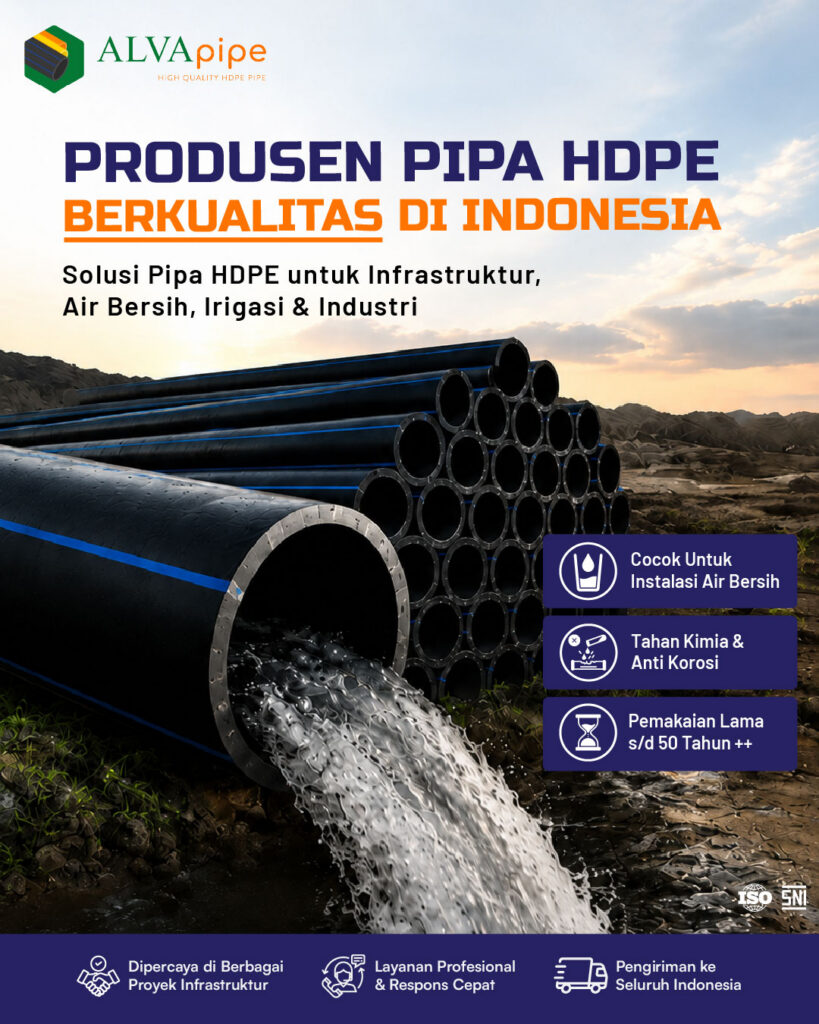
For example, ALVApipe provides HDPE pipes ranging from OD 20 mm to OD 250 mm, allowing both large-diameter main pipelines and smaller lateral lines to be supplied from a single reliable source without requiring coordination with multiple suppliers with inconsistent material quality.
6. Long Service Life with Proper Application
Installing an irrigation system is a long-term agricultural infrastructure investment that is not replaced every year.
Pipe materials with long service life provide better total cost efficiency compared with cheaper materials that require frequent replacement.
Service life should not only be evaluated based on manufacturer claims but also through technical certifications that verify actual performance.
Learn more about HDPE pipe lifespan and the factors affecting its durability.
7. Easy to Install and Maintain
Installation convenience directly affects the cost and time required to build or expand an irrigation system.
Lightweight and flexible materials are easier to transport to agricultural locations and can be installed faster by smaller installation teams.
For example, a 1-hectare agricultural field (10,000 m²) using a drip irrigation system with HDPE pipes:
- Main line: 63 mm diameter, approximately 100 meters long
- Lateral lines: 20 mm diameter, approximately 500 meters total length
A 3–4 person installation team can generally complete the installation within 2–3 working days.
This timeframe includes pipe placement, cutting, and connection using mechanical compression fittings.
Compared with PVC pipes, which are more rigid and require more elbow fittings to follow similar land contours, installation may require an additional 1–2 working days mainly for assembling connection components.
Common Types of Pipes Used for Agricultural Irrigation
The following is a brief comparison of three commonly used pipe types in agricultural irrigation systems, including their advantages, limitations, and typical applications.
| Pipe Type | Advantages | Limitations | Common Applications |
| HDPE | Flexible, corrosion resistant, service life up to 50 years, UV resistant | Higher initial cost compared with PVC | Pressurized irrigation, underground installation, uneven terrain |
| PVC | Affordable, easy installation, widely available | Less flexible, vulnerable to cracking under extreme temperatures | Open irrigation channels, low-pressure systems |
| LDPE | Highly flexible, lightweight, easy to roll and transport | Lower working pressure, weaker structural strength | Drip irrigation, lateral lines |
Why Are HDPE Pipes Widely Used in Modern Irrigation Systems?
Among various available pipe materials, HDPE pipes are increasingly preferred for modern irrigation systems because their technical characteristics provide advantages that are difficult to match with other materials, including:
- Flexible for Different Land Conditions. With elasticity exceeding 700%, HDPE pipes can follow uneven land contours and adapt to soil movement without cracking or leaking.
- Resistant to Corrosion. HDPE materials do not react with fertilizers, pesticides, and soil minerals commonly found in agricultural environments.
- Strong Pipe Connections. When installed correctly, HDPE fusion welding systems create connection points with integrity comparable to the pipe body itself.
- Suitable for Various Pressurized Irrigation Systems. Available in multiple pressure classes from PN 6.3 to PN 16, HDPE pipes can be customized for different irrigation requirements, from low-pressure drip irrigation systems to higher-pressure sprinkler systems.
Learn more about SNI HDPE pipe standards and testing parameters that verify material quality before field application.
Choose the Best Irrigation Pipes with ALVApipe Technical Support
Different pipe types offer different advantages depending on their applications. For modern irrigation systems requiring long-term durability, flexibility across various land conditions, and long-term cost efficiency, HDPE pipes provide a comprehensive technical solution.
PT Alpha Cikupa Makmur through its ALVApipe brand manufactures SNI-certified HDPE water pipes made from PE 100 material, certified under SNI 4829.2:2015.
ALVApipe HDPE pipes are available in diameters from OD 20 mm to OD 250 mm, with pressure classes ranging from SDR 11 to SDR 26.
The ALVApipe technical team is ready to help determine the most suitable specifications based on your irrigation system requirements.
Contact the ALVApipe team via WhatsApp +6287726663295 to receive technical recommendations and the best price quotation.