Runoff water discharge is one of the main foundations in designing dewatering systems for open-pit mining areas. Inaccurate calculations can cause pump capacity and pipeline networks to be unsuitable for actual field requirements, increasing the risk of water accumulation in mining operation areas.
An oversized dewatering system design can also significantly increase investment and operational costs. This article discusses the basic concept of how to calculate runoff water discharge, the factors affecting it, and the next steps after the discharge value has been determined.
How to Calculate Runoff Water Discharge Using the Rational Method
The Rational Method is one of the most commonly used approaches for calculating runoff water discharge in mining areas. This method is selected because the calculation process is relatively simple while still providing a representative estimation of the amount of water entering the mining area during rainfall events.
Rational Method Formula
The calculation of runoff water discharge using the Rational Method uses the following formula:
Q = 0.278 × C × I × A
The value 0.278 is a unit conversion constant used to ensure that the final runoff discharge result is expressed in cubic meters per second (m³/s).
Explanation of Each Variable
Each letter in the formula represents a variable that must be calculated or determined beforehand.
Q (runoff discharge) — the volume of water flowing over the surface, expressed in cubic meters per second (m³/s).
C (runoff coefficient) — a value representing the proportion of rainfall converted into surface runoff, determined based on the type and condition of the land surface.
I (rainfall intensity) — the amount of rainfall occurring within a specific period, generally calculated in millimeters per hour (mm/hour) using the Mononobe formula.
A (catchment area) — the area where rainfall is collected and flows toward a specific point, calculated in square meters (m²) or square kilometers (km²).
Simple Calculation Example
As an illustration, assume a mining area has a runoff coefficient (C) of 0.2, rainfall intensity (I) of 0.0000787 m³/s, and a catchment area (A) of 82,385.99 m². The runoff water discharge calculation is as follows:
Q = 0.278 × C × I × A
Q = 0.278 × 0.2 × 0.0000787 × 82,385.99
Q = 0.360 m³/s
The result indicates the runoff water volume that must be managed by the dewatering system in the mining area. This discharge value then becomes a reference for determining pump capacity, sump dimensions, and the required pipeline network specifications.
Factors Affecting Runoff Water Discharge
The value of runoff water discharge does not exist independently. Several field conditions contribute to determining the amount of water that needs to be managed by a dewatering system.
Rainfall intensity: Describes how much rainfall occurs within a specific period. Areas with high rainfall intensity generally require dewatering systems with larger capacities.
Catchment area: Determines the size of the surface area contributing water flow toward the sump or settling pond. The larger the catchment area, the greater the potential volume of water entering the mining area.
Runoff coefficient: Represents the characteristics of the land surface in absorbing or allowing rainfall to flow. Hard surfaces with limited vegetation tend to have higher runoff coefficients because more water flows as surface runoff.
Land surface conditions: Soil type, land density, and vegetation coverage influence how much water can infiltrate into the ground. Land areas exposed due to mining activities generally have lower water absorption capacity.
Topographic changes caused by mining activities: Land clearing and bench formation in mining operations gradually alter water flow directions. These changes need to be monitored periodically to ensure that discharge calculations remain consistent with the latest mining conditions.
After the Discharge Is Known, What Is the Next Step?
1. Determining Pump Capacity
Pump capacity must be adjusted to the total water inflow entering the mining area, including runoff water discharge, rainfall water, and groundwater inflow. Pumps with insufficient capacity may fail to remove water effectively, while excessive capacity can increase operational costs.
2. Determining Pipe Diameter
The pipe diameter used in a dewatering network must be adjusted according to the water discharge and the planned flow velocity. Proper diameter selection helps maintain water flow efficiency without creating excessive pressure within the pipeline system.
3. Calculating Head Loss
Head loss or pressure loss in a pipeline network is influenced by pipe length, the number of bends, and friction caused by water flow inside the pipe. Calculating the total pump head, which includes static head, velocity head, and friction head, is necessary to ensure that the selected pump can transport water to the final discharge point.
4. Determining Sump Location
A sump functions as a temporary water storage area before water is pumped out of the mining area. The location and dimensions of the sump must be designed based on the maximum possible runoff volume, including during long-duration rainfall conditions.
5. Evaluating the Overall System Capacity
After all components have been determined, a comprehensive system capacity evaluation is still required to ensure that pumps, pipelines, and sumps can operate as an integrated system. Periodic evaluations also help anticipate changes in field conditions caused by mining progress or variations in rainfall patterns.
Why Does Pipe Selection Also Affect the Dewatering System?
Runoff water discharge calculations must also be supported by selecting appropriate pipe specifications to ensure that the dewatering system operates optimally.
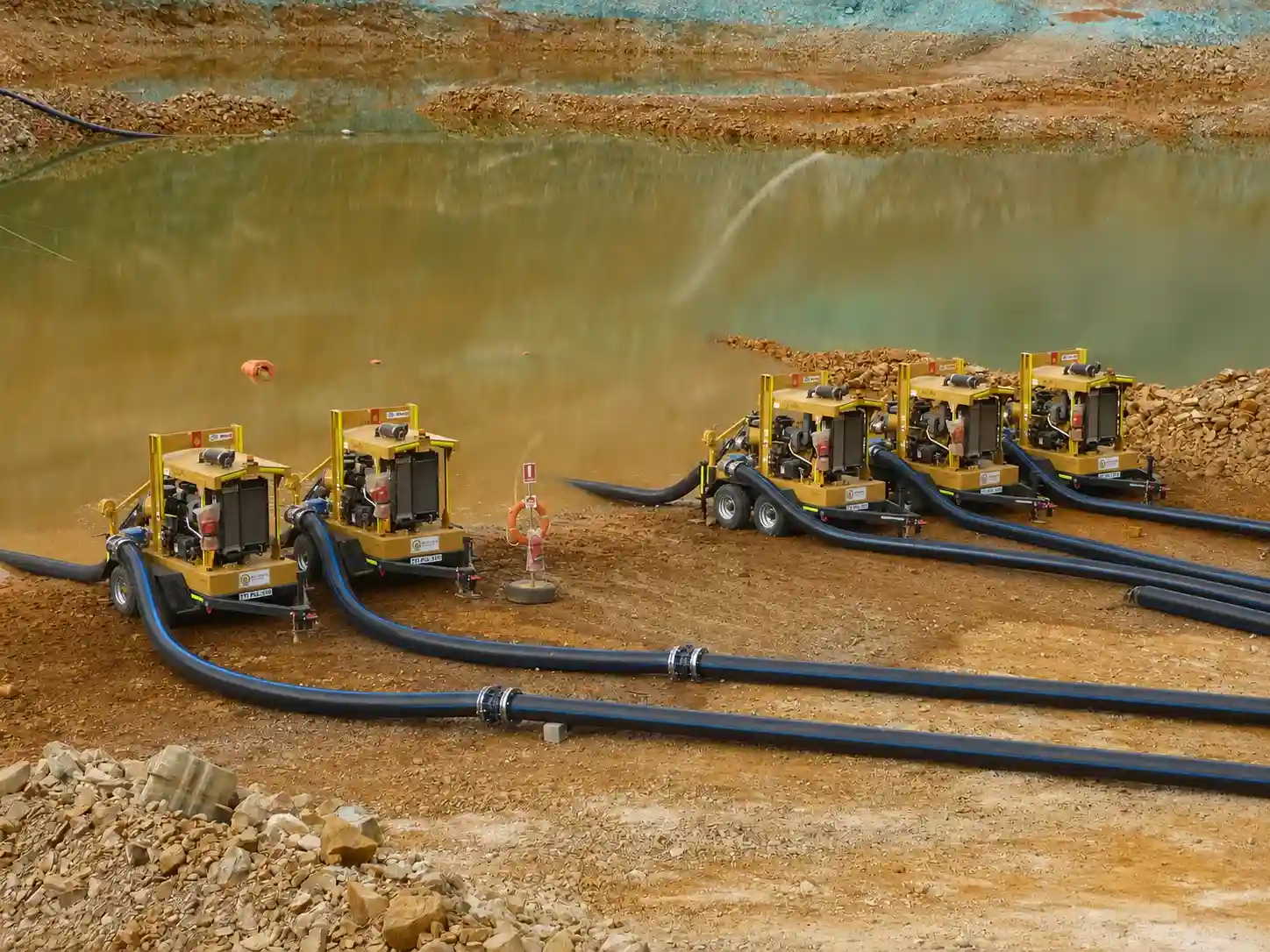
Pipe diameter affects the water flow capacity that can be accommodated and transported toward the sump or settling pond. Pipe material affects resistance to mining operational conditions, including exposure to weather, pressure, and contact with solid materials such as sludge and sand.
Head loss within the pipeline network is influenced by system design, including the number of bends and the total pipeline length. Pipe specifications must be adjusted according to the calculated discharge value to ensure that the dewatering system capacity remains suitable for mining area requirements.
HDPE pipes are one of the widely used options in mining dewatering systems due to their characteristics of high pressure resistance and durability under harsh field conditions. After determining the discharge value, pump selection, pipe diameter, and system configuration must be designed as an integrated system to ensure all components operate efficiently.
Recommended Mining Dewatering Pipes from ALVApipe
Based on documented field practices from several open-pit coal mining case studies in Indonesia, ALVApipe HDPE pipes can be a relevant choice for various segments of mining dewatering systems, including:
- High-pressure main discharge lines:
ALVApipe HDPE pipes OD 110 mm to 250 mm SDR 11 (PN 16) are suitable for discharge lines from deep pits to settling ponds with high total head requirements. - Medium-pressure distribution lines:
ALVApipe HDPE pipes SDR 17 (PN 10) are suitable for secondary distribution lines or systems with lower head requirements. - Lateral collection lines:
ALVApipe HDPE pipes with smaller diameters, OD 20 mm to 63 mm, are suitable for collecting water from the lowest points of the pit toward the main sump.
PT Alpha Cikupa Makmur, through the ALVApipe brand, manufactures HDPE water pipes made from PE 100 material certified with SNI 4829.2:2015, available in diameters ranging from OD 20 mm to 250 mm with various pressure classes from SDR 11 to SDR 26.
As a direct manufacturer operating since 1998, ALVApipe is ready to become your HDPE pipe procurement partner for mining dewatering system requirements.
Let’s contact the ALVApipe team now via WhatsApp +6287726663295 to get the best offer for SNI-certified HDPE water pipes to support your store inventory needs. We are ready to assist you!