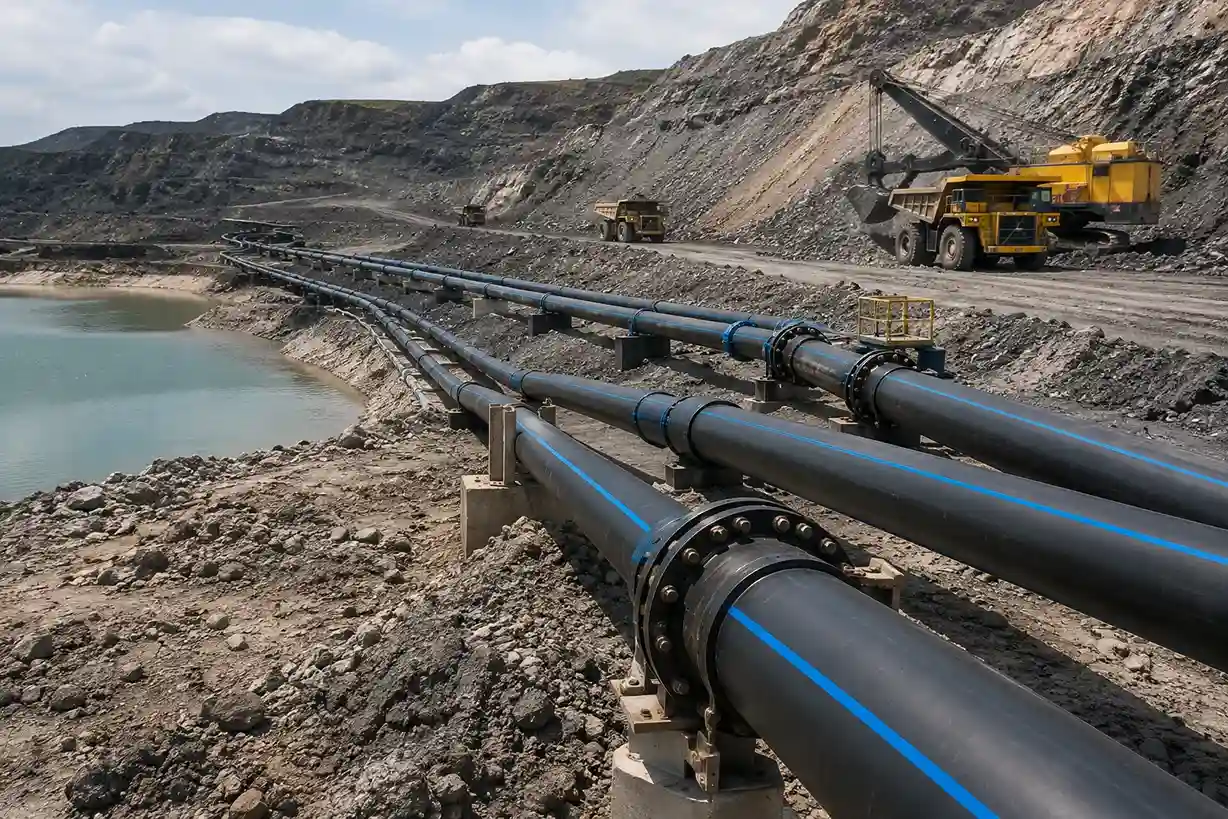
When dewatering capacity begins to feel insufficient, many companies choose to add more pumps. At first glance, this approach appears to be the fastest solution to remove more water from the pit.
However, adding pumps does not always solve the problem. If pit conditions have changed, the piping network is no longer efficient, or the existing system is no longer suitable for operational requirements, dewatering performance will remain suboptimal.
Signs Your Mine Dewatering System Needs Redesign
Referring to the journal titled Technical Study of Mine Dewatering at Open Pit Mine PT. Putra Muba Coal, Musi Banyuasin Regency, South Sumatra Province (2023) by Pratama et al. and the journal titled Technical Planning of Mine Dewatering at Sump Pit Tempudo 4 PT Kalimantan Prima Persada at PT Indexim Coalindo, East Kutai Regency, East Kalimantan Province (2025) by Anapah et al., the following are several signs that indicate a mine dewatering system needs to be redesigned.
1. Sump Continues to Overflow Even When All Pumps Are Operating
If the sump continues to overflow even when all pumps are operating, it indicates that the capacity of the dewatering system may no longer be sufficient. This condition shows that the incoming water volume is greater than the system’s ability to store and discharge it.
A similar condition was found in the open pit mining study at PT Putra Muba Coal, South Sumatra (Pratama et al., 2023). The study recorded water inflow reaching 1.1961 m³/second, originating from three catchment areas and direct rainfall.
This condition indicates that dewatering problems cannot always be solved by adding pumps alone but also require an evaluation of the overall system design.
2. Actual Rainfall Exceeds the Initial Design Assumption
A dewatering system must be designed to handle high rainfall conditions. Otherwise, the system will become more easily overwhelmed during the rainy season.
The study by Pratama et al. (2023) at PT Putra Muba Coal showed that the maximum daily rainfall reached 183 mm/day. This value was even higher than the 5-year return period design rainfall of 166.457 mm/day.
These findings indicate that system design must consider the possibility of extreme rainfall events to ensure it can continue controlling water entering the mining area.
3. Pit Expansion Changes the Catchment Area
Every pit expansion changes the size of the rainfall catchment area flowing into the sump. The larger the exposed mining area, the greater the water volume that must be handled by the dewatering system.
The study by Anapah et al. (2025) at PT Indexim Coalindo showed that Pit Tempudo 4 has two rainfall catchment areas with a combined area of more than 236 hectares. The active mining area also has a higher runoff coefficient compared to forested areas.
As the pit develops, more rainfall runoff will flow into the sump even if rainfall intensity remains unchanged.
4. Water Volume in the Sump Continues Increasing Beyond Planned Capacity
Water balance must be evaluated regularly to ensure that pumping capacity can still compensate for incoming water flow. If water volume continues increasing despite pumps operating, the dewatering system may no longer match actual field conditions.
The study by Anapah et al. (2025) at PT Indexim Coalindo showed that the water volume in Sump A reached 250,240 m³ and Sump B reached 76,810 m³. With two pump units having a capacity of 800 m³/hour, the required drainage time still reached 13–28 days. Such conditions indicate that the dewatering system needs evaluation to ensure it can effectively handle water discharge.
5. Sedimentation Reduces Effective Sump Capacity Faster Than Expected
Sump capacity can decrease as sediment accumulates. If deposits continue to increase, the available water storage volume becomes smaller, causing dewatering system performance to decline.
The study by Anapah et al. (2025) estimated that approximately 11,200 m³ of sediment accumulated in the sump within one month. If sediment levels continue increasing in the field and are not immediately managed, sump storage capacity will continue decreasing, forcing pumps to work harder to control water.
6. Total Pump Head Is No Longer Suitable for Developing Pit Conditions
As the pit becomes deeper, the load that pumps must overcome to transport water to the surface increases. If pump specifications are no longer suitable for these conditions, pumping capacity may decrease even though the pumps continue operating normally.
The study by Anapah et al. (2025) showed that the required total head at the research location reached 127 meters for Sump A and 116 meters for Sump B. These findings indicate that pump specifications need to be evaluated periodically to ensure they continue meeting dewatering requirements as pit conditions change.
7. Mining Sequence Changes Alter Sump Position and Requirements
Changes in mining plans often cause existing dewatering systems to become unsuitable. As pits become deeper, enter the backfilling stage, or expand into new areas, dewatering requirements must also be adjusted.
The study by Anapah et al. (2025) showed that changes in the mining plan at Pit Tempudo 4 required the dewatering system to be redesigned so mining activities could continue according to production targets. This condition demonstrates that dewatering systems need evaluation whenever major changes occur in mine design or mining stages.
The Role of Pipes in Dewatering System Performance
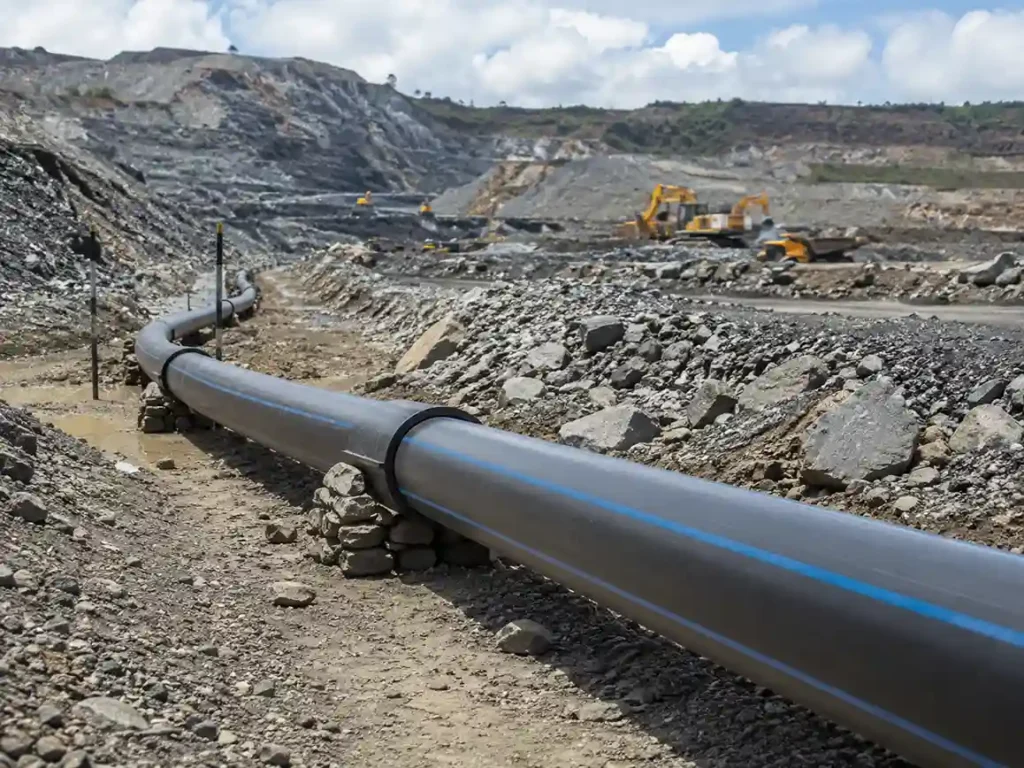
The selection of discharge pipes also affects dewatering system performance. Pipes with the right specifications can reduce pressure losses (head loss), allowing pumps to operate more efficiently.
The study by Anapah et al. (2025) at PT Indexim Coalindo used HDPE pipes with a diameter of 14 inches and a length of 2,500 meters as the discharge pipeline.
The results showed that the pumps achieved approximately 70% efficiency, allowing the system to maintain optimal performance.
These findings indicate that pipe specification selection should be an important part of evaluation when designing or upgrading a dewatering system.
Why Do Many Dewatering Projects Use HDPE Pipes?
HDPE pipes are commonly used in mine dewatering systems because they can support pumping performance while withstanding harsh working conditions.
The study by Anapah et al. (2025) also stated that PT Indexim Coalindo uses HDPE pipes as the standard material for its dewatering system.
Some of the main reasons include:
- Reduce head loss. The smooth internal surface of HDPE pipes reduces water flow friction, allowing pumps to operate more efficiently.
- Resistant to mining environments. HDPE material does not easily corrode and can withstand mine water containing sediment, mud, and various chemical substances.
- Easy to relocate. Its lighter weight and flexibility make installation and relocation more practical when mining areas change.
- More secure connections. Fusion joints create a more leak-resistant pipeline, reducing the risk of leakage in discharge lines.
ALVApipe HDPE Pipe: Piping Solution for Mine Dewatering Systems
PT Alpha Cikupa Makmur through its ALVApipe brand manufactures PE 100 HDPE water pipes suitable for mine dewatering applications with the following technical specifications:
Material: PE 100, density 0.94 gr/cm³, tensile strength above 22 MPa, elasticity above 700%.
Diameter: OD 20 mm to OD 250 mm, covering requirements from small-diameter lateral collection lines to large-diameter discharge main lines such as those used in the Anapah et al. (2025) study with a 14-inch diameter (OD ±355 mm). For requirements beyond these standard specifications, the ALVApipe team is open to providing customized solutions.
Pressure classes:
- SDR 11 / PN 16 for high-pressure discharge lines from deep pits
- SDR 13.6 / PN 12.5 for medium to high pressure applications
- SDR 17 / PN 10 for medium-pressure distribution lines
- SDR 21 / PN 8 and SDR 26 / PN 6.3 for gravity lines and low-pressure applications
Certification: SNI 4829.2:2015 from the National Standardization Agency, TKDN 69.42% from the Ministry of Industry, and ISO 9001 for production quality management systems.
ALVApipe has been directly manufactured from its factory facility in Tangerang since 1998 as a direct producer, offering more competitive pricing with verified quality consistency in every production batch.
Consult your HDPE pipe requirements for your mine dewatering system with ALVApipe today! Contact the ALVApipe team via WhatsApp +6287726663295 for technical discussions and the best price quotation.