How to install HDPE water pipes can be done without a machine using compression fittings for smaller diameters, or using heating methods such as butt fusion for larger networks. Joint strength depends not only on the tools used, but also on surface cleanliness, proper installation techniques, and the quality of the pipe used.
Small mistakes when joining pipes often only become visible after the network starts carrying water. Uneven pipe ends, a displaced O-ring, or a fusion joint that has not cooled sufficiently can become weak points even when the pipe used has good specifications.
Preparing Tools and Materials Before Installing HDPE Water Pipes
Before thinking about how to join the pipes, first pay attention to the condition of the pipe ends. This is the part that will later meet the fitting or another pipe and receive pressure when the network starts operating.
Angled cuts or surfaces that are still exposed to soil and oil can affect the joint result. Therefore, preparation should not be considered a minor step that can be skipped.
Types of Cutting Equipment and Joint Accessories Required
For compression fittings, prepare a pipe cutter capable of producing a straight cut, measuring tools, a marker, and fittings that match the pipe’s outside diameter. A chamfer tool can be used if the fitting instructions require the pipe end to be slightly smoothed to prevent damage to the seal during insertion.
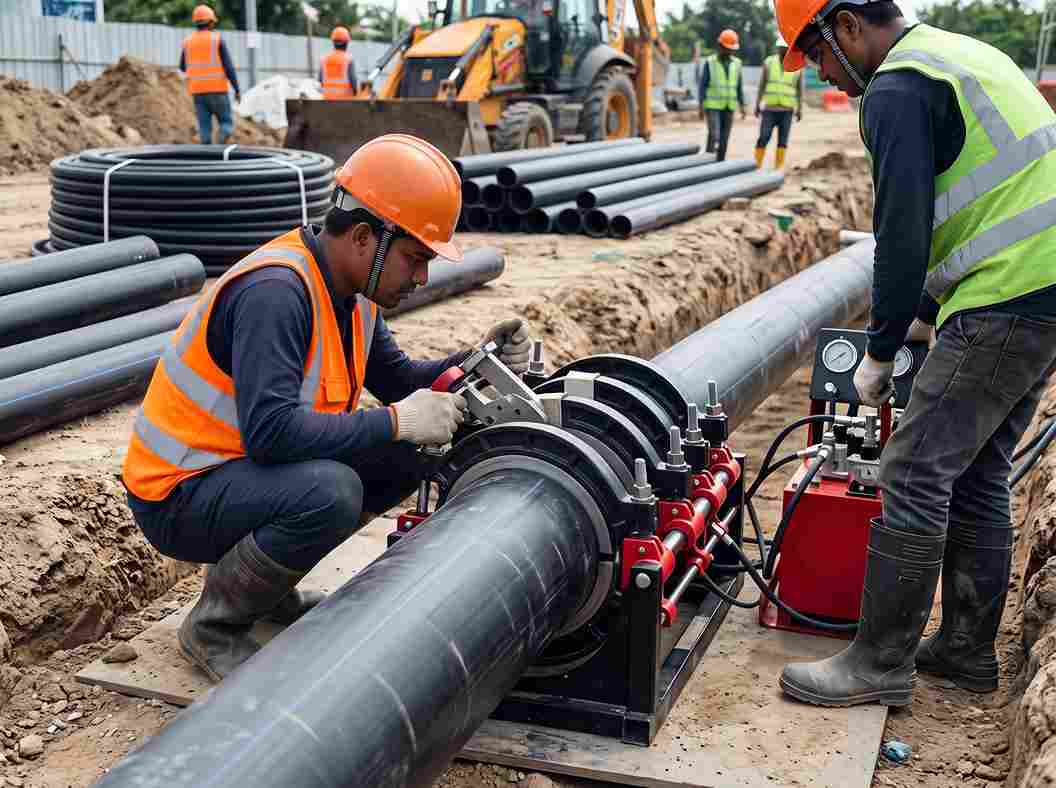
For butt fusion, the required equipment is different. Technicians need a clamping machine, a facing tool to level both pipe ends, and a heater plate as the heat source.
Electrofusion uses special fittings with heating elements inside, along with a control unit to run the fusion process.
When obtaining pipes from an HDPE pipe factory, make sure the outside diameter, SDR, PN, and joining method have been determined from the beginning. The joint components used then need to be matched with the specifications of the pipe.
Cleaning and Preparing HDPE Pipe Ends
The pipe ends need to be cleaned of dust, sand, mud, oil, and water before the joining process.
For butt fusion, both pipe ends are first clamped and then leveled using a facing tool. This process ensures that the two surfaces to be joined are properly aligned and level.
Once the surfaces have been prepared, avoid touching them again with dirty hands. In electrofusion, the area that will be inserted into the fitting also needs to be prepared according to the installation procedure so that the surfaces being joined remain clean.
How to Install HDPE Pipes Without a Machine Using Compression Fittings
For household connections or relatively small-diameter networks, compression fittings are a practical option because they do not require a heating machine.
This method is suitable when the work requires simpler installation, as long as the fitting size and rating match the pipe being used.
Step-by-Step Guide to Installing Mechanical Fittings for Small-Diameter Pipes
Start by cutting the pipe straight across. Check the cut end again and remove any sharp edges if necessary.
Loosen the lock nut on the fitting. On some fitting models, the components do not need to be completely removed. If the fitting needs to be disassembled, the arrangement of the locking ring, seal, and other components must be restored according to the manufacturer’s instructions.
Insert the pipe end straight. Push it until it reaches the limit or stopper inside the fitting. Do not stop when the pipe has only passed the seal because the insertion depth also determines the strength of the joint.
Once the pipe is in the correct position, the lock nut can be tightened.
Tips for Tightening the Lock Nut to Prevent Leaks
The assumption that the lock nut must be tightened as tightly as possible can actually cause problems.
The O-ring requires the correct position and pressure to create proper sealing. If the pipe is inserted at an angle, there is dirt on the seal, or the fitting components change position while being tightened, the joint may not function properly.
Tighten the lock nut according to the fitting instructions. Once finished, gently pull the pipe to ensure that it is securely locked and check again that the joint remains straight.
The next stage is just as important. Do not immediately cover the installation before the network has undergone pressure testing.
HDPE Pipe Joining Methods for Project-Scale Applications Using Butt Fusion and Electrofusion
For larger networks, joints using heating processes are widely used because they can form permanent connections between PE materials.
However, a heating machine does not automatically guarantee a strong joint. The operator still needs to understand the pressure, heating time, pipe position, and cooling time according to the procedure being used.
HDPE Pipe Welding Procedure Using a Butt Fusion Machine
The two pipe ends are first positioned and secured in the machine. The facing tool is then used to create even surfaces.
After alignment has been checked, the heater plate is placed between the two pipe ends. The surfaces are heated until the required melting condition is reached. The heater is then removed, and the two pipe ends are immediately brought together using the appropriate pressure.
At this point, a bead or circular fold usually forms around the joint area.
The pipe must not be moved immediately after the fusion is completed. The joint needs to remain stable during the cooling process. Once sufficiently cooled, the fusion result is inspected to check the uniformity of the bead and the condition of the joint.
Temperature, pressure, and cooling time should not use a single value for all diameters. The parameters need to follow the pipe size, wall thickness, machine, and procedure being used.
Advantages of Electrofusion Techniques for High-Precision Joints
There are conditions in the field where a butt fusion machine is difficult to position. The workspace may be narrow, there may be a connection to an existing network, or the pipe position may not provide enough space for the machine.
Electrofusion can be an alternative in such conditions.
Electrofusion fittings have heating elements inside them. After the pipe surface has been prepared and the pipe has been inserted to the specified depth, the control unit supplies electrical energy so that the fitting and pipe fuse together.
This method provides flexibility for certain installation conditions. However, electrofusion must still follow the appropriate rating and procedures according to the network design.
HDPE Underground Pipe Installation Guide
Once the joints are completed, the next challenge comes from the soil conditions.
HDPE is flexible, but the pipe still requires even support. Avoid placing the pipe directly on sharp rocks or an uneven excavation base.
Bedding can use suitable granular material so that the bottom of the pipe receives proper support. The sides of the pipe are then filled and compacted gradually so that the soil load can be distributed more evenly.
So, what is the correct depth for HDPE pipes?
There is no single number that automatically applies to every project. The depth must consider the pipe diameter, soil conditions, vehicle loads above the pipeline, groundwater level, and project design requirements.
Therefore, a pipe route in a residential yard cannot always be treated the same way as a network running beneath a road.
How to Test HDPE Pipe Joint Leaks After Installation
This stage is often considered the final step, even though it is actually the last opportunity to identify problems before the network becomes difficult to access.
Before final backfilling is carried out, the network can undergo a hydrotest using water. The system is filled, air is removed, and the pressure is then increased according to the predetermined testing procedure.
The purpose is not simply to see whether any water is dripping. The test is carried out to ensure that the network and joints can maintain their integrity when subjected to pressure.
The pressure level and testing duration must follow the system design and project procedures. Diameter, pressure rating, network length, temperature, and material characteristics also affect the testing process.
If any issues are identified, repairs are much easier to carry out while the joints are still accessible than after the entire excavation has been closed.
Consulting for SNI-Standard HDPE Pipe Supply
Proper installation techniques will be more meaningful when the materials used also have clear specifications.
ALVApipe Water uses PE100 HDPE and has SNI 4829.2:2015 as well as a TKDN of 69.42 percent. The product is designed for water distribution needs and has an estimated service life of up to around 50 years under suitable operating conditions.
When comparing HDPE pipe manufacturers and HDPE pipe distributors, do not only look at the price difference. The diameter, SDR, PN, product standards, and suitability for the network requirements need to be checked from the beginning.
Access to Bulk Ordering through the Official Website and Sales Consultant
For large-scale network requirements, the required quantity of pipes should be calculated based on the pipeline length, diameter, pressure class, and installation requirements before placing an order.
Purchasing directly from an HDPE pipe manufacturer provides an opportunity to discuss specifications from the beginning. As an HDPE pipe manufacturer, ALVApipe has a production facility in Tangerang and serves both project requirements and smaller-volume purchases.
Convenient Retail Purchases through the Official Marketplace
Not all pipe requirements involve project-scale volumes. For home network repairs, simple installations, or small-quantity purchases, selected ALVApipe pipe products can be checked through the Official Marketplace on Shopee and Tokopedia.
These channels are more practical for buyers who already know the type, diameter, and pressure class of the pipe they need. Prices, stock availability, promotions, and shipping programs follow the marketplace conditions at the time of transaction.
A durable HDPE network is not determined by just one neatly finished joint. The result comes from a series of decisions, starting from selecting the pipe, preparing the joint ends, determining the installation method, placing the pipe underground, and conducting testing before the network is put into use.
Installation techniques and material quality need to work together. A pipe with good specifications still requires proper installation, while neat workmanship will deliver more optimal results when using materials that match the pressure and requirements of the network.
For project requirements, bulk procurement, or custom diameters, prepare information regarding the diameter, SDR or PN, network length, required quantity, and delivery location. To consult about installation techniques, project material quantity calculations, or price quotations from the factory, you can directly contact the ALVApipe team via WhatsApp at +6287726663295 or click the Contact Us button below.