In 2014, a city in Michigan, United States, experienced one of the most serious clean water crises in its history.
An aging water distribution pipe that failed to meet proper material standards caused water to become contaminated with lead at levels that endangered the health of tens of thousands of residents.
This Flint water crisis became a stark reminder that piping infrastructure directly affects the safety of the communities that depend on it.
For this reason, compliance with piping material quality standards must always be the top priority in every infrastructure development project.
Quality standards serve as a guarantee that installed pipes will perform according to their specifications under operational conditions for decades to come.
Unfortunately, in real-world procurement practices, quality standards and certification often take a backseat to price.
Understanding Water Pipe Quality Standards
Quality standards in the context of piping refer to a set of technical requirements that a pipe product must meet in order to be deemed suitable for a specific application.
These standards cover material specifications, dimensions, mechanical strength, pressure resistance, and material safety relative to the quality of water flowing through the pipe.
Technical standards provide a consistent framework for manufacturers during the production process, for contractors during installation, and for infrastructure managers during long-term maintenance.
Without mutually agreed-upon standards, every party in the project chain may apply a different definition of “quality.”
Common parameters regulated under water pipe standards include:
- Outer dimensions and pipe wall thickness
- Maximum operating pressure
- Tensile strength and material elongation
- Resistance to extreme temperatures
- Resistance to corrosion and chemicals
- Food-grade safety requirements for pipes carrying drinking water
All of these parameters are derived from extensive research and testing to ensure pipe performance under real field conditions.
Why Quality Standards Matter in Water Distribution Systems
1. Ensuring Infrastructure Safety
Pipes that do not meet the correct mechanical strength standards risk failing under normal operating pressure.
A failure at a single point in a piping network can cause distribution disruptions, property damage near the leak, and safety risks for workers and the surrounding community.
Quality standards ensure that every pipe entering the system has been tested and proven capable of withstanding the operational loads it will face.
2. Maintaining the Quality of Distributed Water
Pipe materials that do not meet food-grade safety standards may leach harmful compounds into the water flowing through them.
Contamination can occur gradually and go undetected in the short term, but its effects accumulate over time.
The World Health Organization (WHO), in its drinking water quality guidelines, emphasizes that materials in direct contact with drinking water must meet safety requirements to prevent both chemical and biological contamination.
For HDPE pipes, for example, food-grade standards ensure that the material does not react with water or release harmful substances even after decades of use.
3. Ensuring Product Specification Consistency
In large-scale projects, thousands of meters of pipe from multiple production batches must be joined into a single cohesive network.
If dimensions or tolerances vary between batches, installation becomes more complex and joints between pipes may not seal properly.
Quality standards ensure that pipes from the first batch and the fiftieth batch have identical dimensions and specifications, allowing the entire system to function uniformly without requiring field adjustments.
4. Supporting Regulatory Compliance and Project Requirements
Water infrastructure projects, particularly those funded by government or international institutions, consistently require the use of materials certified to specific standards.
Disregarding these requirements can result in document rejection, project delays, and legal complications down the line.
Common Water Pipe Standards and Certifications
1. International Organization for Standardization (ISO)
For HDPE pipes, ISO 4427 governs the technical requirements for polyethylene pipes used in water distribution systems. This standard covers dimensional specifications, pressure ratings, and material quality.
2. Standar Nasional Indonesia (SNI)
SNI is the mandatory standard applicable in Indonesia. SNI ISO 4427, covering HDPE pipes for drinking water, adopts the ISO standard with adjustments suited to Indonesian conditions and regulations.
Products certified under SNI have undergone testing recognized by the national standardization authority.
3. ASTM International
A U.S.-based standards organization with global recognition. ASTM standards for HDPE pipes — such as ASTM F714 and ASTM D3035 — are widely referenced in projects with international specifications.
4. American Water Works Association (AWWA)
AWWA publishes standards specifically for drinking water distribution systems, including AWWA C901 and C906 for polyethylene pipes.
AWWA standards are highly specific to water distribution network applications and are frequently referenced in municipal-scale water utility projects.
Why Certification Matters in the Procurement Process
1. Reducing Technical and Operational Risk
Certification is the result of independent testing that verifies a product genuinely meets its claimed specifications.
By selecting certified pipes, project managers reduce uncertainty regarding product performance in the field.
2. Supporting Project Transparency and Accountability
In projects involving multiple stakeholders, product certification provides an objective basis for quality verification.
All parties from the project owner to contractors and supervising consultants can refer to the same certification documents as a shared quality benchmark.
3. Meeting Regulatory and Tender Requirements
In Indonesia, the Minister of Public Works and Housing (PUPR) regulations require the use of SNI-certified products for certain infrastructure projects.
Beyond domestic regulations, piping projects funded by international institutions such as the World Bank or the Asian Development Bank (ADB) typically carry their own set of standard requirements that must be fulfilled.
4. Protecting Long-Term Investment
Piping systems are built with a target service life of 30 to 50 years. Every procurement decision made today will therefore carry consequences for decades to come.
By selecting pipes that have passed certification and proven their durability, stakeholders can protect their initial investment by preventing cost overruns caused by premature pipe replacement due to material failure.
Risks of Using Pipes Without Clear Standards or Certification
The following risks deserve careful consideration:
- Inconsistent material quality. Without quality standards, pipes from one batch may pass testing, while the next batch falls well below expected specifications.
- Risk of leaks and structural failure. Minor undetected leaks can escalate into major failures, particularly in high-pressure systems or those running through densely populated areas.
- Potential water contamination. Pipe materials that do not meet food-grade standards may release harmful compounds, effects that often go undetected until the problem has already spread.
- Repair costs and operational downtime. The costs arising from below-standard pipe failures far exceed the price difference between certified and non-certified products.
Regarding repair costs, a simple simulation can illustrate the difference.
Suppose a water distribution network project requires 1,000 meters of HDPE pipe. A SNI-certified pipe is offered at IDR 85,000 per meter, while an uncertified pipe is available at IDR 60,000 per meter.
The difference appears significant. IDR 25,000,000 for the total procurement.
However, two years after installation, three leak points are discovered due to material inconsistencies between batches. Excavation and repair costs reach IDR 15,000,000 per point, a total of IDR 45,000,000.
The system must be shut down for four days for repairs, with operational downtime costs estimated at IDR 20,000,000.
On top of that, post-repair water quality testing adds IDR 8,000,000, and potential service delay penalties amount to IDR 10,000,000.
The total additional costs come to IDR 83,000,000, more than three times the initial savings of IDR 25,000,000.
And this is only a mild scenario involving three leak points. If failures occur at more points or in critical segments, the figures could be significantly higher.
This is the essence of total cost of ownership. The upfront purchase price is only a small component of the overall costs that will be incurred throughout the service life of the piping system.
How to Verify Pipe Standards and Certification During Procurement
The following steps can be taken:
- Request official certification documents from the manufacturer or distributor. A valid certificate typically includes a registration number, the issuing body, the validity period, and the scope of products covered.
- Confirm that the listed standards match the project specifications. Certification for gas pipe applications differs from that for drinking water pipes, the two cannot be used interchangeably.
- Verify the certification body that issued the document. For the Indonesian market, one recognized certification body is the National Accreditation Committee (Komite Akreditasi Nasional / KAN).
- Review the manufacturer’s track record, including projects that have previously used their products.
Meet Your Quality HDPE Water Pipe Needs with ALVApipe!
Quality standards and certification represent one of the key benchmarks for safe and durable piping systems. Procuring pipes without adequate standard verification may appear cost-effective upfront, but the risks prove far more expensive in the long run, from repair costs and operational disruptions to potential legal consequences.
For water pipe needs, SNI-certified HDPE pipes that comply with international standards such as ISO 4427 have proven their value across numerous utility projects throughout Indonesia. So, make the right choice from the start, choose pipes that are certified, tested, and trusted.
ALVApipe is ready to be a reliable partner for water infrastructure projects of any scale.
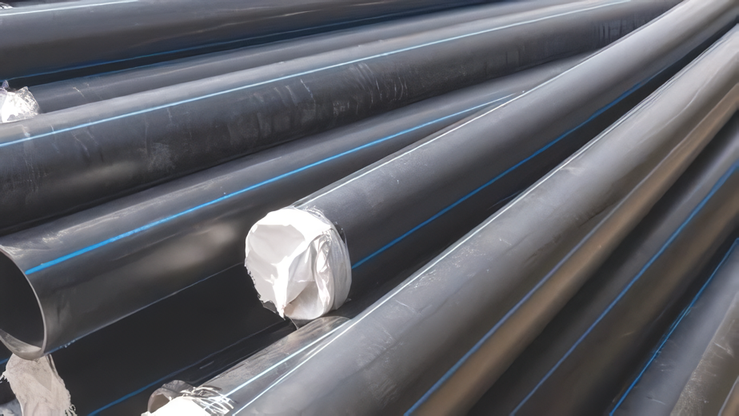
Through its ALVApipe Water product line, HDPE pipes specifically designed for water distribution are available with a black body and blue stripe material, offering tensile strength above 22 MPa, elongation of up to 700%, corrosion and abrasion resistance, and a smooth interior surface to minimize pressure loss throughout the network.
Lightweight, durable, and SNI-certified, ALVApipe Water pipes are built to last up to 50 years under normal operating conditions, making them a long-term investment worth every rupiah.
Contact the ALVApipe team today and get the best solution for water distribution needs!