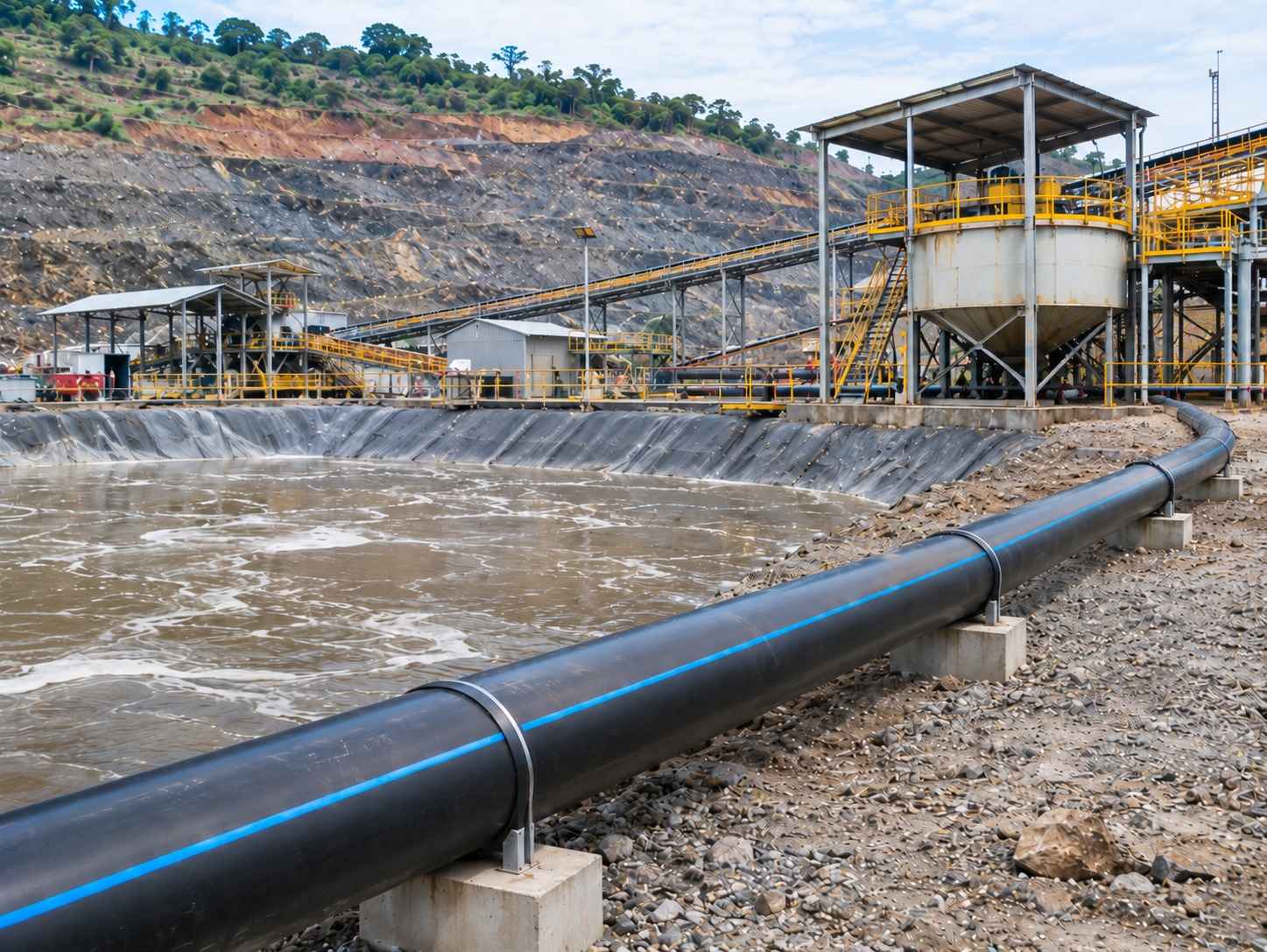
Using HDPE pipes to handle slurry in mining areas is an option worth considering when a project needs a transport line for a mixture of water and solid particles. Polyethylene has good abrasion and corrosion resistance, but its service life is still affected by particle characteristics, solids concentration, flow velocity, pressure, and installation design.
The Tough Side of Mining: The Challenge of Moving Thick Slurry
In mineral processing areas, work does not stop once the rock has been excavated. The material still has to be processed, separated, and then conveyed to the next stage. In this process, water often mixes with sand, fine gravel, rock fragments, or mineral particles to form slurry.
This mixture behaves differently from ordinary water. Solid particles keep moving with the flow and interact with the inner surface of the pipe. Over time, this friction can wear down the pipe wall, especially if the mixture contains hard, sharp-edged particles.
For site managers, the problem is not just worn pipes. Replacing a line can disrupt operating schedules, add maintenance work, and increase costs over the life of the installation.
Why Are Slurry Transport Lines Prone to Wear?
Wear in slurry lines is known as abrasion. It happens when solid particles rub against or strike the inner surface of the pipe as the fluid moves.
The level of abrasion is not the same in every installation. Factors to consider include:
- Particle size and shape: Hard, large, or sharp-edged material can speed up wear.
- Solids concentration: The more particles carried in the mixture, the greater the potential contact with the pipe wall.
- Flow velocity: The wrong velocity can cause settling or increase the intensity of particle impact.
- Line design: Bends, diameter changes, joints, and flow transitions need to be considered because they can be points with a higher risk of wear.
This means choosing the pipe material alone is not enough. A slurry transport system must be designed so particles stay suspended in the flow without excessive settling or uncontrolled wear.
Using HDPE Pipes for Slurry Handling in Mining Areas
Pipes made of High-Density Polyethylene (HDPE) are widely considered for a number of granular material and slurry transport applications. The toughness and corrosion resistance of polyethylene are an advantage over materials prone to electrochemical corrosion.
HDPE also has the mechanical strength and flexibility to support its use in pressurized piping networks. This makes HDPE pipe a viable choice for mining environments with long installation routes and varied terrain.
However, abrasion resistance does not mean the pipe wall will never wear. Choosing the wall thickness, diameter, and pressure class, and evaluating the slurry characteristics, are still necessary before setting the final specification.
A Smooth Inner Surface and Its Effect on Flow
The smooth inner surface of HDPE pipe helps reduce resistance to fluid flow. In slurry systems, this is one aspect to consider together with flow velocity and particle characteristics.
If the velocity is too low, particles can settle at the bottom of the pipe. On the other hand, an unplanned increase in velocity can also increase particle impact. That is why the engineering team needs to set operating conditions based on hydraulic calculations, not just rely on the smooth pipe surface.
Material Flexibility and Joint Planning
The flexibility of HDPE helps adjust the installation route to certain contours. Fusion joining can also produce fully fused joints when the procedure, temperature, pressure, and timing are properly controlled.
Even so, bends, elevation changes, supports, and mechanical protection must still follow the project design.
Why Is ALVApipe Water Worth Considering?
ALVApipe Water is an HDPE pipe product from PT Alpha Cikupa Makmur. It is corrosion- and abrasion-resistant, impact-resistant, and flexible, with a smooth inner surface.
These characteristics make ALVApipe Water worth considering as the best HDPE pipe for water distribution needs that match its specifications. For mining slurry transport, product suitability must be confirmed through a dedicated technical evaluation, because the available product certification is for water supply systems, not a specific slurry certification.
ALVApipe Water holds SNI 4829.2:2015 product certification and a TKDN (local content) value of 69.42%. The company also applies the ISO 9001:2015 quality management system.
Pipe Procurement and Delivery Support for Mining Projects
With production facilities in Cikupa and the Jatake Industrial Estate, Tangerang, ALVApipe provides piping products for a wide range of project needs.
Project managers can review the specifications on the ALVApipe website, while marketplace purchases are available at ALVApipe on Shopee. For projects in various regions, delivery across Indonesia is available, with volume, specifications, destination, and schedule confirmed before ordering.
Before choosing a material for slurry, prepare information on the particle type, solids concentration, flow rate, pressure, temperature, and route conditions. This data will make the pipe requirements evaluation more focused. Want to discuss HDPE pipe needs and request product information for your mining project? Contact the ALVApipe team via WhatsApp +62 877-2666-3295, or click the Contact Us button below to share your project needs and get more information.