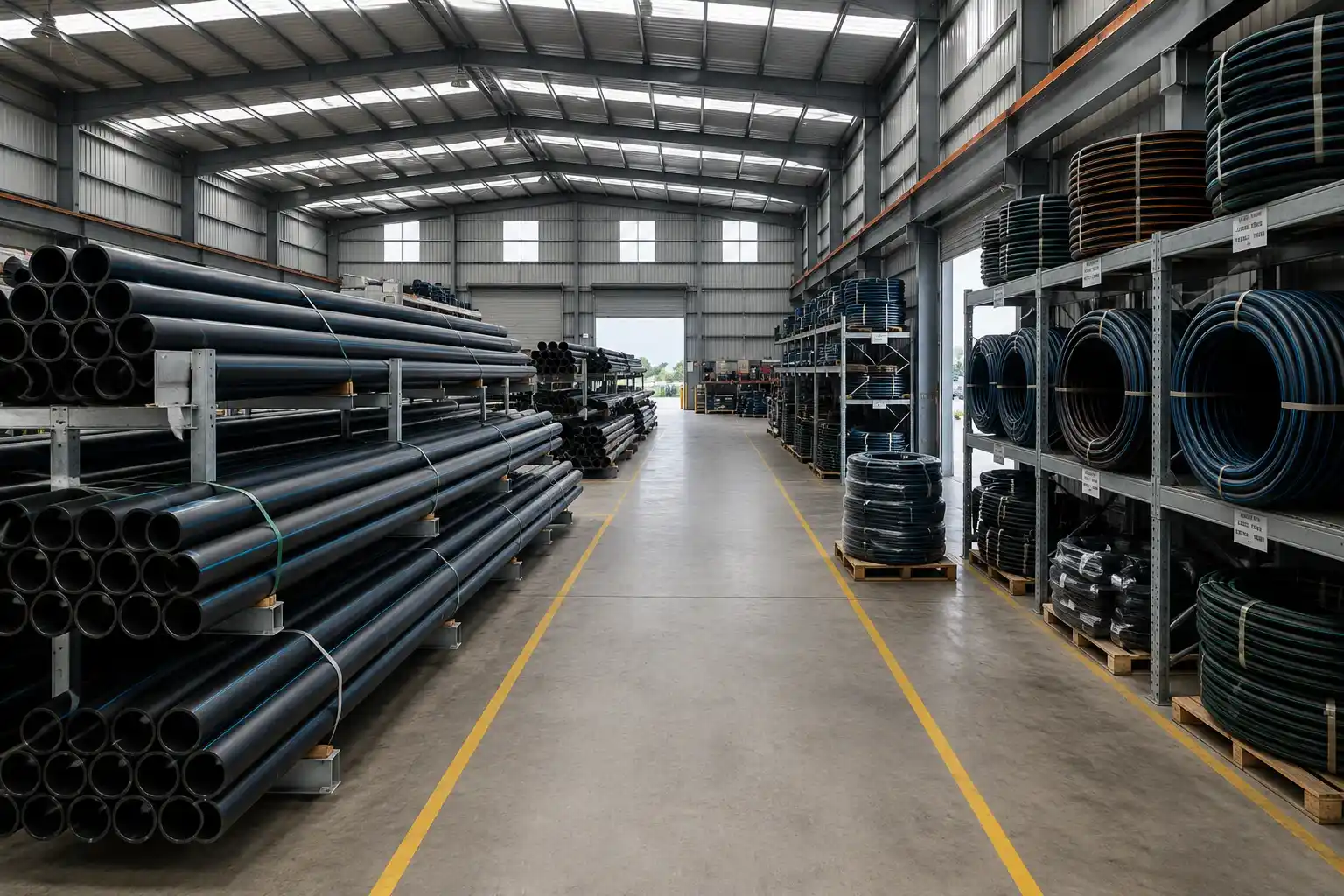
Whether they realize it or not, many pipe store owners still overlook the proper way to store HDPE pipes in warehouses.
In fact, improper storage can compromise pipe quality before the products even reach customers.
Before complaints start coming in, it is best to implement proper storage standards, ranging from temperature control and stacking systems to protection against UV exposure.
Read the complete guide below!
Understanding the Characteristics of HDPE Pipes
Before discussing storage methods, it is important to understand the characteristics of HDPE material itself.
HDPE pipes are well known for their flexibility, with elasticity exceeding 700%. However, this flexibility also means that the pipes can undergo permanent deformation if stored incorrectly over a long period of time.
In addition, HDPE is sensitive to prolonged exposure to heat and UV radiation. The recommended storage temperature for HDPE pipes ranges from -20°C to 40°C. Above 40°C, the material may soften, affecting the pipe’s dimensional accuracy and mechanical strength.
Long-term direct sunlight exposure can also degrade the outer layer of the pipe and reduce its material strength. HDPE pipes stored outdoors without protection in hot climates may experience UV degradation within just a few weeks.
However, HDPE is actually an extremely durable material when handled properly. Pipes stored outdoors with adequate protection can still last for up to 12 months.
Proper Ways to Store HDPE Pipes in a Warehouse
1. Store in an Area Protected from Direct Sunlight
Store pipes indoors or under a roof that shields them from direct sunlight. If storage in a semi-open area is unavoidable, use opaque, UV-resistant covers.
One important thing to note: avoid using black tarpaulins or black plastic sheets as covers.
Dark-colored materials absorb heat and can increase the surface temperature of the pipes, accelerating material degradation.
Instead, use light-colored covers that reflect heat and are specifically designed to resist UV exposure.
2. Use Pallets or Supports
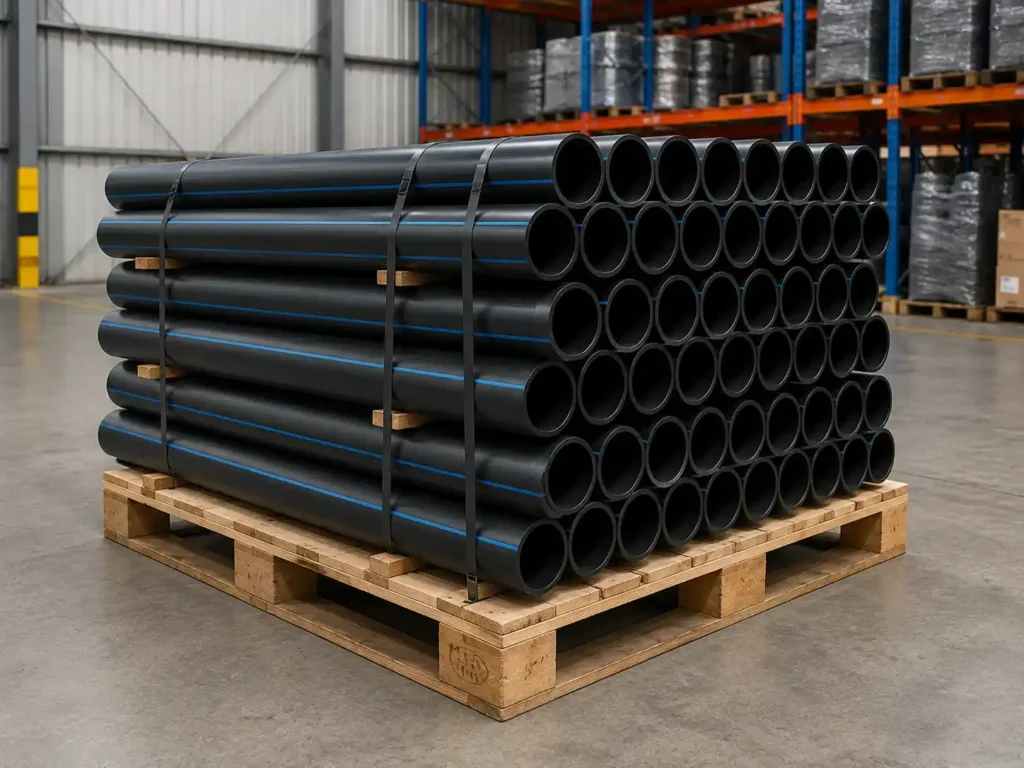
Never store pipes directly on soil, rocks, or uneven surfaces. Use at least three pallets or wooden supports distributed evenly along the length of the pipe.
Ideally, the supports should elevate the pipes at least 10 cm above ground level to ensure proper air circulation beneath the stack and prevent moisture from seeping into the material.
For 6-meter-long pipes, use a minimum of three wooden supports. For pipes shorter than 4 meters, two supports are sufficient, with spacing between supports not exceeding 1.5 meters.
3. Arrange Pipes Neatly and Securely
Store HDPE pipes horizontally in a parallel and orderly arrangement.
Never insert smaller-diameter pipes inside larger-diameter pipes during storage. This practice increases the load and pressure on the lower pipes, potentially causing deformation.
It is recommended to use stoppers or restraints on both sides of the stack to prevent the pipes from rolling.
For large-diameter pipes, additional support frames can be installed at both ends to maintain stability.
4. Pay Attention to the Stacking System
Avoid stacking pipes too high, as the continuous pressure from the upper layers places excessive loads on the pipes at the bottom. Over time, this can result in permanent deformation.
Below are general guidelines for stacking HDPE pipes:
- The maximum stack height for standard-diameter pipes is 1.5 to 2 meters.
- For pipes with diameters exceeding 500 mm, the maximum stack height is 2.5 meters, with wooden spacers placed between each layer.
- The total number of layers should not exceed five.
- Larger and heavier pipes should always be placed at the bottom layer.
- Each layer should be separated by evenly spaced wooden supports to ensure proper load distribution.
If pipes have already deformed due to improper stacking, measure the internal diameter horizontally and vertically.
If the horizontal diameter is larger than the vertical diameter, rotate the pipe by 90 degrees and leave it for at least six hours before installation to allow the material to recover closer to its original shape.
5. Maintain Proper Warehouse Ventilation
Ensure that the warehouse has adequate ventilation to keep temperatures within a safe range. Avoid storing pipes near heat sources such as machinery, generators, or walls exposed to prolonged sunlight.
The recommended storage temperature for HDPE pipes is below 40°C. Temperatures above this level increase the risk of material deformation.
6. Implement the FIFO System
The FIFO (First In, First Out) system ensures that pipes received first are also sold first. This prevents older stock from being buried behind newer inventory while newly arrived products continue to be sold first. To make this process easier, label each incoming batch of pipes with its receiving date.
Quick Guide: Do’s and Don’ts
| ✅ Do | ❌ Don’t |
| Store pipes in shaded or enclosed areas | Leave pipes exposed to direct sunlight |
| Use light-colored, opaque, UV-resistant covers | Use black tarpaulins as covers |
| Elevate pipes at least 10 cm above the ground | Store pipes directly on soil or rocks |
| Limit stack heights to 1.5–2 meters | Exceed the recommended stacking height |
| Place larger pipes on the bottom layer | Insert smaller pipes inside larger ones |
| Implement the FIFO system | Ignore stock rotation |
| Separate each layer with wooden supports | Stack pipes directly without spacers |
Risks of Improper HDPE Pipe Storage
- Pipe Bending or Deformation. Pipes stored incorrectly or stacked beyond safe limits for extended periods may undergo permanent deformation that cannot be corrected.
- UV Degradation. Direct exposure to sunlight without proper protection can begin damaging the outer layer of the pipe within a matter of weeks.
- Reduced Performance During Use. Pipes that have degraded during storage may fail to deliver performance that meets their technical specifications once installed.
- Customer Complaints and Business Losses. Customers who receive pipes in less-than-perfect condition may lose trust in your store, potentially affecting repeat business and your reputation.
Store HDPE Pipes Properly and Choose the Best from ALVApipe!
Proper HDPE pipe storage is part of a store’s operational standards and should never be overlooked.
Follow all of the guidelines above, from maintaining storage temperatures below 40°C and protecting pipes from UV exposure with suitable covers to keeping stack heights below 2 meters and implementing the FIFO system.
You can also learn more about the quality standards that water pipes should meet in your store and understand the role of HDPE pipe manufacturers in maintaining inventory stability from production to distribution.
In addition to good storage practices, partnering with a manufacturer that maintains product quality from production through delivery is equally important.
As an HDPE pipe manufacturer, PT Alpha Cikupa Makmur, through its ALVApipe brand, produces high quality HDPE water pipes with consistent standards in every shipment.
ALVApipe HDPE pipes are manufactured using premium-grade HDPE material that is resistant to corrosion and abrasion, flexible with elasticity exceeding 700%, lightweight with a density of 0.94 g/cm³ for easier installation, and designed with an estimated service life of up to 50 years.
Every ALVApipe product is also certified with SNI and TKDN, recognized by the Indonesian Ministry of Industry, ensuring reliable product quality.
Contact the ALVApipe team today via WhatsApp at +62 877-2666-3295 for consultations and the best pricing tailored to your store’s needs!